Friday, July 20, 2012

Kutch Crafts part 3 - Printing with blocks of wood

Ajrakh Block Printing


"Ajrakh" is an Arabic world referring to the moment when the sun hovers on the horizon, and the sky is red, blue, and black dotted with stars.

The artisans of Dhemadka and Ajrakhpur have been making traditional Ajrakh block prints for eleven generations, attempting to capture that moment.

One artisan, Abdul Rauf, told me once that "in order to be a designer, you have to have your eyes open. Nature is a designer, so as an artisan designer you choose to either copy or edit the things you see and the traditions you learn."

Nature is definitely a part of the Ajrakh craft. One artisan told me that the craft was originally developed so that shepherds would stand out against the harsh desert landscapes of Sindh and Kutch, in contrast with the white and brown clothing they had previously worn.

The process involves a lot of water -- specifically, quality water. For this reason, artisans must dig deep into the ground to reach good water sources. With environmental changes in Kutch, however, the water tables are changing, and Dhemadka can no longer sustain the craft. For this reason, the community of Dhemadka decided to build a new village - called Ajrakhpur - closer to the city and near a better water source.

Today there are dozens of block printers in Ajrakhpur, with an increasingly international market. Ajrakh is probably my favorite craft that my organization (Khamir) works with.

The Process

Several villages in Kutch specialize in wooden block-making,
selling to Ajrakhpur, Dhemadka, and elsewhere. 

For every color a different block must be made. The block makers therefore have to
 have a complex understanding of negative space.

That black gunk is actually the resist used to create white spaces on the cloth.
When the cloth is washed, it comes off, leaving the original color underneath.

Colorful dyes waiting to be used.


The artisan uses blocks to create layers of design on long pieces of fabric.
They must be precise and quick.

Adding a layer of color requires matching up the block perfectly on the design.
Some textiles have four or five colors, and many more blocks. You can see the skill as the artisan works. 


On the studio wall in Dhemadka, color has built up over time,
creating what I think is a gorgeous abstract design in itself.


The cloth is dyed with a base color, then cleaned with water.


Drying in the sun - some of these cloths will be further printed or dyed to create even more elaborate designs.

A complete product.

This Ajrakh piece is over a hundred years old and made with natural dyes and traditional blocks
- some still being used today, some have been lost.


On a visit to Dhamadka (the original Ajrakh village), my coworkers and
 I decided to make a handkerchief together - with varying levels of success.
I am responsible for the blocks WAY too close to the edge.

Disha shows off our group effort. We were pretty proud of the design we created in the middle using blocks and my fingertips. You will also notice we signed our names in the corners.


Thursday, July 12, 2012

Crafts in Kutch Part 2 - Molding Earth

Pottery


In Hindu mythology, Bhrama, the Creator of the Universe, made a clay model of a human into which he breathed life. For this reason, the Hindu potter is known as Prajapati, meaning the creator of humanity. The Kumbhar (potters’) communities of Kachchh and throughout India have a strong religious connection with their work. They believe that the god Shiv has blessed them with protective fire and a consistent work that will always be enough to sustain their families. Pottery is particularly meaningful to the craftspeople because its creation represents the culmination of all five of the Hindu elements: fire, water, earth, air, and akasha (space).


Crafting earth
Kachchhi potters must have an intimate understanding of the environment for their craft to thrive.  
To collect quality clay, potters in the Banni region travel far into the grassland seeking dense clusters of vegetation. They know that where there are grasses there will be a subterranean water source, and therefore a smooth, quality clay pocket perfect for ceramics. The potters of Tuna near the sea wade directly into the water to collect clay from below their feet. Here the clay is salty and porous, able to hold water and keep it cool.

To obtain the black, red and white clays used both for building and decorating their pots, artisans collect white china clay and mineral-rich red and black clays from specific pockets in the area. The geographic knowledge and ability to assess quality of these sources is passed down from generation to generation.  When the monsoon season begins and clay becomes less accessible, the potters give up their craft temporarily, focusing on seasonal agricultural work.

In its form and practice, the Kachchh pottery craft represents a deep-rooted understanding of the environment as well as representing a model of local, natural, and sustainable craft practice. 

The Process


Sara-bai is the region's most accomplished potter, and when you see her painting skills you understand why. She is also a wonderful person - when I met her she gave me a big hug and smile that made me feel immediately comfortable.

If you have ever done pottery in school, you at least know the basic technique of wheel throwing, What makes the Kachchhi style unique is that they use a stick to turn the wheel by hand like a top.


Firing the pots in a big pit.

Sara-bai's adorable granddaughters on their way to Arabic lessons after school.
(Unrelated, but I had to include this photo)
White, black and red slips are used for decoration. The brushes are all pieces of wood that are frayed at one end.
This is one reason Sara-bai's detailing is so amazing.


Sara-bai paints delicate lines using a thick wooden brush.


I tried painting a scrap with the wooden brushes. SO HARD.
Sara-bai did like my bird motif, though.


Some finished products.

Instead of keeping water in the fridge (which many people don't have), people in Kachchh (and around India)
 keep water in a pot like this. The porousness of the clay keeps the water cool. 

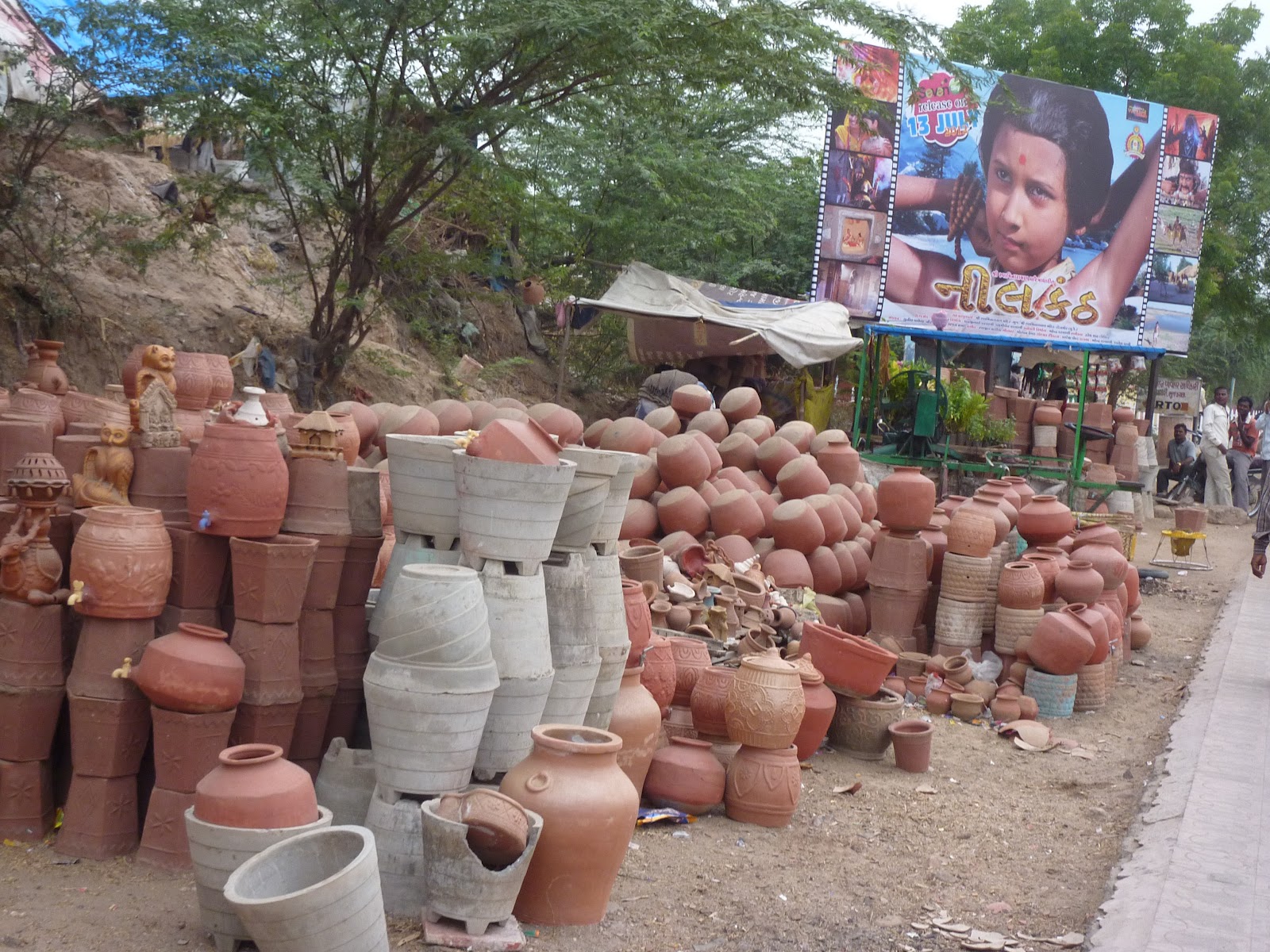
Vendors in Bhuj sell pots on the side of the road. 


Terracotta and the stages of life
In Kachchh, as in other parts of India, pottery plays an important ritualistic role in the cycle of life. Communities use dozens of forms of terracotta to correspond with the different stages of life: clay bowls holding oils, water, leaves, and coconut are used as part of the sixth-day chahti ceremony that marks the birth of a child; small lamps are used daily for ritual pujas;  terracotta of many sizes and shapes are used as part of the marriage ceremony to hold up the wedding canopy and to contain smaller ritual items such as water, rice, oil, ghee, and khum khum (red paste);  the clay is shaped into animals as children’s toys; into lamps for festivals; and into special bowls for use in the death ceremony.

Hindu tradition teaches that porous earthenware absorbs dirt and negative energy.  Rules of ritual pollution therefore require people to discard and replace earthenware during festivals and significant occasions such as births, marriages, and deaths.  As a result of this belief, potters have historically enjoyed a stable local market for their craft.

An Ancient Lineage
Modern Kachchhi pottery traces its roots back thousands of years to the time of the Indus Valley Civilization.  One of the world’s earliest urban civilizations, the Indus Valley Civilization spread across the western region of South Asia (in what are now Pakistan, Eastern Afghanistan, and Northwestern India including Kachchh) from 3300-1300 BCE. The civilization is noted for its architectural accomplishments such as building cities of brick, roadside drainage systems, and multistoried houses, along with a number of handicrafts that include pottery.

Today, the potters of Kachchh continue to practice their craft in much the same way as their geographic ancestors. Collecting clay from pockets in the region, building up pots by hand or on the wheel, and painting their products with motifs passed down through the generations, many modern terracotta pieces reveal the influence of the ancient pottery of the region. At the same time, today’s potters take artistic liberties in order to market to new audiences, creating a variety of products for both the local market and beyond.

Fragment of pottery from Indus Valley Civilization


Painted Pottery Around India
Pottery is one of the most universal of all crafts – terracotta is found on every continent and the craft has been practiced for thousands of years. In India alone there are dozens of pottery styles, forming objects that transgress barriers of caste and religion and are used at every stage of life.
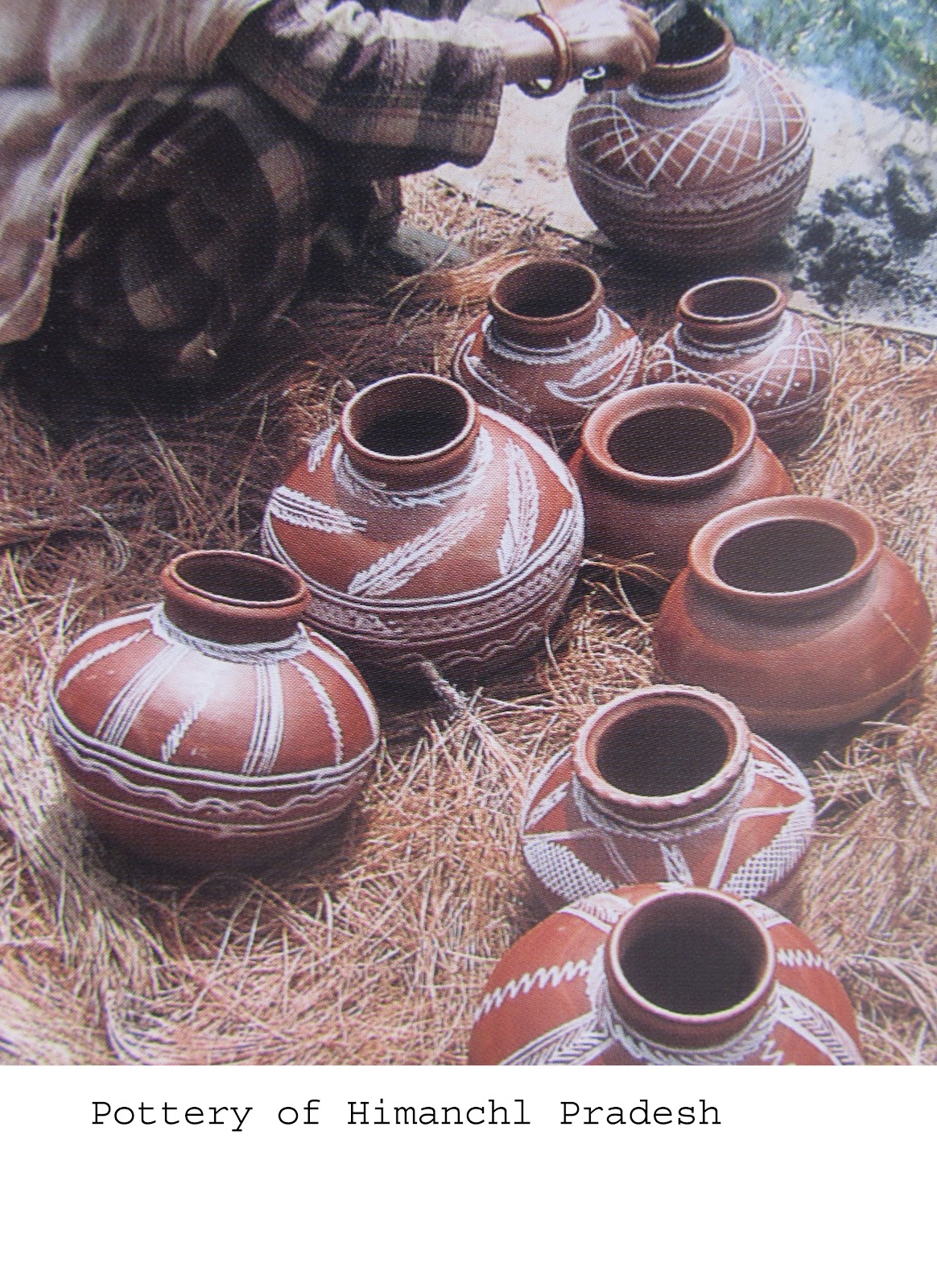
Despite the ubiquitous nature of pottery, only a few regions within India boast the kinds of intricate painting techniques found in Kachchh. In Rajastan, bold blocks of white and red highlight the complicated black designs painted on top. Potters in Himachal Pradesh paint white lines directly onto red surfaces, which become discolored as part of the smoke fire process that defines the region’s work.

In Kachchh, potters paint delicate black and white designs over their red-coated terracotta or red and black designs on white coated pieces.  Many of the motifs are similar to those discovered at Indus Valley Civilization sites in the region such as Dolevida and Lothal, suggesting a remarkable continuity in design passed down from generation to generation.  In addition, the similarities in design among pottery in Northern India and Eastern Pakistan suggest the history of trade and migration that have historically linked these regions.


Wednesday, July 11, 2012

Crafts in Kutch Part 1 - the Bells, Bells, Bells, Bells, Bells, Bells, Bells.


For those of you who missed it, I work at an NGO called Khamir, which supports sustainable livelihoods for artisans and craftspeople in the Kutch region. Considering how very present crafts are in my daily life, I am embarassed at how little I have said about them on my blog. Many people talk about how uniquely colorful Kutch is compared with other parts of India, despite it being a desert. Much of this has to do with the beautiful clothing people wear, but it is also a result of the many crafts that are a part of peoples lives. If you don't have many trees or flowers in your surroundings, you capture the essence of the pockets of beauty you do see and make it a part of yourself.

From the little time I have spent in these craft communities, what sticks is the sense of being contained in the crafts. For the communities, the point isn't the product, but the knowledge and history contained in it. Therefore craft isn't an individual expression (as is art) but the expression of time and a community's identity.

There are dozens of crafts in Kutch, so I am going to focus on just a few, in a series of posts so as not to overwhelm you.

Starting with . . .


Metal Bells


In communities throughout the Banni region, water buffalo and cows are the key to livelihood, as I explained briefly in an earlier postWater buffalo, cows, sheep, goats, and camels provide milk, which nourishes the family, is a source of income, and acts as a bartering tool in communicating with other communities. They produce dung, which is one of the primary building materials in the Banni region. The first milk that comes out of the cow after it gives birth is even considered to be healing. As is reflected in the multifarious uses of water buffalo and cow products, the communities of the Banni live a generally sustainable lifestyle, making use of all the resources available to them.  

Similarly, the development of the bell-making craft reflects the integral role livestock hold in pastoral communities. Originally from Sindh (now a part of Pakistan), the Luhar community migrated to Kachchh hundreds of years ago, bringing with them centuries of experience creating bells to monitor the whereabouts of their cattle.  Today, the Luhar community is spread among five villages in Kachchh, creating bells that communities throughout the region utilize.


Water Buffalo wearing a bell.

Water buffaloes being herded.

In addition to reflecting the livelihood of their community, metal bells also represent a sustainable craft practice in themselves. Created out of recycled waste metal, they are hand shaped, coated in a mixture of local clay and raw cotton, dipped in a mixture of powdered brass and copper, and fired. When the clay/cotton mixture is peeled away, the bells are buffed and tuned, revealing a mix of colors and sounds totally unique from bell to bell. 

The Process

Waste metal is collected from the community as well as
from nearby industry. This metal forms the base of the bell.

The artisan cuts the scraps into the appropriate shapes,
then pounds the metal into a  hollow cylinder.


The artisan creates a small cap of metal and attaches it to the base of the bell.

Women mix local clay and raw cotton.

Women cover each metal bell with the clay/cotton mixture.


They roll the clay- covered bell in a powder of brass and copper.

An artisan roasts the copper bell directly in the flame.


They remove the bells (usually four small ones are baked together in a clump).

And break off the clay/cotton mixture to reveal the bell.


The bells are polished, revealing a variety of colors leftover from
the reaction with the copper, that make each bell unique.

Each bell is tuned to a different note by banging
small indentations into the form of the bell itself.
Here, my coworker demonstrates the different notes of the bells.

Each bell is tuned to a different note, so that herders can keep track of exactly which cows are where. When an animal is troublesome, the herder hangs a large bell around her neck. The deeper sound of this bell calms the animal, just as it alerts the herder to the whereabouts of their disobedient charges. 

Today, the use of Kachchh’s traditional bells has expanded; they hang in entrance ways, are combined with metal frames to create wind chimes, are finely tuned to become musical instruments, and are used as other forms of festive decoration.