Monday, March 12, 2012

Holi Smokes!


Why exactly don’t Americans play holi? It involves throwing colors at everyone you see (including your boss), mud wrestling, bonfires, and people of all ages acting like children. I say we bring this tradition to the homefront.

I guess I was catching up for lost time, because I got to play holi twice.

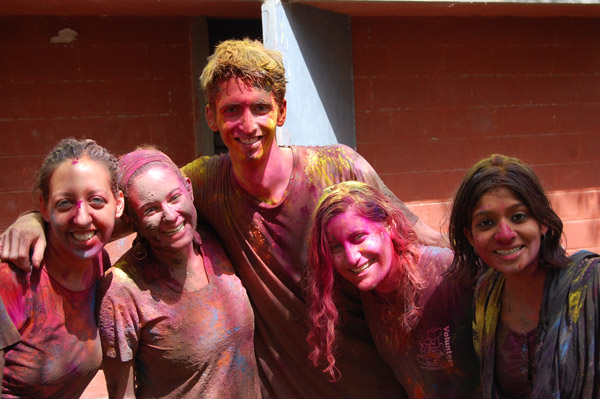
At exactly four pm on Wednesday afternoon, my coworkers and I all converged outside our office, holding little plastic bags of powdered color. We stared at each other, waiting to see who would make the first move. I honestly don’t know who it was, but all at once someone was smudging green on my face and another was throwing pink in my hair. It didn’t take long before I was dusting people with orange and smacking color on people’s backs. Puffs of blue, yellow, and red rose above us like thought bubbles as we laughed and splattered each other with colors. Two of my coworkers picked up a third and carried him halfway across the campus, dumping him into the water vat in the dyeing unit. The head of the dyeing unit turned on the hose and started spraying everyone with water. The result was that we all ended the day nearly as clean as we started, and we all went home happy and a little damp.


That night I came home to find the women from my apartment sitting in a circle in the street by my building, backs turned inward towards a pile of burning coal, coconuts, popcorn, and newspaper. I sat down with them, and they explained that they had earlier done a puja (a ritual which many hindus do twice a day as well as on special occasions) and were now curing their back pain in the holy fire. We chatted awhile and sat silently longer.

Early Thursday morning, I put on a t-shirt and sweatpants and left my house. I have not gone out in public without a kurta and dupatta once since coming to Bhuj, but today I was not willing to risk any of my clothes being destroyed. As I walked to Matt’s house I saw a group of men playing brass instruments and throwing colors, as well as some children who looked like crayon boxes. But in general the streets were calm.

I was greeted at Matt’s by a water balloon hitting my shoulder, and found Matt, Ariella, and Luisa (the other foreigners working at NGOs in Bhuj) crouched behind a wall waiting to strike. I joined them as we watched for our other “teammates” to arrive, Priyanka and Siddarth (both Matt’s coworkers). Unfortunately, they found us first.

It turns out holi day one was NOTHING. At work we had used powdered colors and water. Period.

Priyanka and Siddarth were attacking us with liquid colors that dripped down our faces and into our eyes, eggs cracked on our heads and squirt guns of water. Sid squeezed red color into my hair in a long stream, and I retaliated with my sad bag of powdered color. Then we piled into a rickshaw, colors running down our necks, and drove to our boss’s house.


If I thought day one of holi was proof that there is no divide between the personal and professional (a much bigger topic which I will discuss later), day two taught me I was VERY wrong. We showed up at the home of the Power Couple (I will call them Mr. and Ms. PC), who are the heads of Matt and Ariella’s organizations, respectively. Priyanka walked up to their gate trick-or-treat style, and tried to get in. Mr. PC hesitated, but somehow she convinced him to let us enter. At first we were just putting powdered colors in their hair and they were doing the same to us. Then it devolved into everyone throwing dirt and mud and leaves at each other and wrestling in a pool of muddy water on the ground, all seven of us plotting ways to lure the neighbors (also Matt’s coworkers) over so we could attack them with color. Ms. PC went to the neighbor’s house to draw them out and found they were waiting for us to come to them. In the end we all met in the street West Side Story style, throwing colors and smudging faces amid a chorus of “happy holi!” and “nice to meet you!” (that was me).


The whole experience was rather like a team-building activity you do at summer camp. But better, because afterwards everyone looks ridiculous and you cannot possibly be self-conscious when you know you look like Rainbow Brite. We ended up staying at Mr. and Ms.PC’s house for chai and lunch before heading to our homes to try washing off the colors.

Seven baths and three days later, I still have splotches of pink on my skin and my hair looks like Gwen Stefani in her No Doubt years. So, all around, successful.

So, who wants to play holi with me this time next year in the US?


Thursday, February 23, 2012

American Dreams


I stood in front of the sparkling glass bottles of basil and oregano, boxes of wheat Chex cereal, and bags of strawberry Twizzlers in awe. I felt almost giddy as I reached up to a shelf and put a jar of olives in my shopping cart.

Friends, I found WHOLE WHEAT PASTA. And CHEESE.

I was obviously dreaming. How could I possibly be in India and also holding Dijon mustard? This was clearly an oxymoron, I had NEVER seen these items in Bhuj, how could they exist in Ahmedabad? But here they were, gleaming on shelves beneath a sign reading “International Foods.”

After three intense weeks of working every day including Sundays, plus three nights until 2:30am (more details on that later), I was totally exhausted. So I hopped on an overnight bus to Ahmedabad, where my friend and fellow Fellow Adva graciously let me appear for a weekend of not being in Bhuj. When I arrived I was totally and utterly emotionally exhausted, and starting to feel claustrophobic. Getting to Ahmedabad was both a relief and a shock: after the quiet pace of Bhuj, the city felt like a mess of sounds and colors and Western clothing. And I was shocked to be standing in a mall nicer than the Mall of America, in front of items I haven't seen in months.

I consider myself a fairly conscious consumer. I read every single ingredient list, without fail, and always ask myself if I can make something before buying it. I reject the notion that as an American one of my primary identities is to be a consumer. Yet as I held a jar of raspberry jam (with actual raspberry in it!) I felt like I was home.

Sitting by the man-made lake eating peanut butter on brown bread, I felt confused. I had never so blatantly experienced the connection between products and identity until that moment, and was embarrassed to realize that I had internalized one of the most obnoxious stereotypes of Americans – that we buy identity and find comfort in consumption.

As I become more comfortable in Bhuj, I no longer think about the fact that I live in a rather small desert town where the only non-Indian food options are paneer pizza and “Chinese” dosas, and where everyone assumes the white people all know each other (which tends to be true). Then the equilibrium tips and I suddenly feel totally out of my element. My escape is consumption , usually of media– I have already rewatched the entire four season series of Mad Men, not to mention three seasons of 30 Rock. I escape into nostalgia, familiarity, the idea of America.

And when I experience the (often justifiable) contempt some people feel for the West, I sometimes find myself defending my country. The other day I actually said to someone in earnest “I love America!” and immediately felt uncomfortable. Because when I think of people who shout out “I love America!” I think of people who spend more time defending flags than humans. But it turns out that being an American actually is an important part of my identity – and apparently consuming things makes me feel safe.

As I rode the bus home from Ahmedabad, using my bag of Western gems as a back pillow, I decided that it was okay to think of these items as comforting. I just couldn’t use them as a crutch. I have been back in Bhuj for a month and still relish the fact that I have olives in my refrigerator.

Why am I telling you all this? Because this feeling isn't unique to my being in India, it's just more obvious because it stands in contrast with the pace of life here. So I want to remember this feeling, and share it with you.

Tuesday, February 14, 2012

Come on in!

After an embarrassingly long hiatus, I thought I would make it up to you by inviting you into my apartment in Bhuj. I, for one, am always curious about how other people live.

I live in a two bedroom apartment in Bhanushali Nagar, a neighborhood rebuilt after the 2001 earthquake that destroyed much of Bhuj and inspired a distinct form of urban sprawl. In an effort to be as earthquake resistant as possible, very few buildings in the city are more than a few stories high, and the taller buildings that remain from before the earthquake are generally empty. In addition, new houses are built as free-standing structures instead of row houses, in order to prevent the kind of destruction that occurred in 2001. Everyone has a story about the earthquake, and many of them are quite painful. About 20,000 people died in the Kutch region on Republic Day, January 26, 2001, and about 400,000 homes were destroyed. Redevelopment is ongoing, and Kutch is often seen outside the region as an example of inspiring regrowth after tragedy. The affects of this rapid growth, I would add, are not always good, but that is a topic for another post.

Today my neighborhood boasts a few big houses and more apartments, the one grocery store in Bhuj, a neighborhood shop that grinds its own flour, plus plenty of dogs and cows. There is no such thing as centralized waste management, so I put my "compostables" in a concrete cylinder outside the building for the cows (see photo below); everything else goes in the other concrete cylinder, which is burned once in awhile and inhaled by everyone in the community. I try not to think too much about this.

I am on the first floor, which we in the States would call the second floor.

Inside you will find:
*A beautiful neon Ganesha to welcome you, thanks to my former roommate, Vrunda. I intend for him to be passed on to future AJWS Fellows.
* A "shower" room, with a nozzle for water to fill a bucket for bathing. I use a heating rod to heat the water, which involves electricity going into water. You can imagine why it took me awhile to actually buy the heating rod.
*Indian squat toilet
*My bedroom, which has a little outside seating area
*The "extra" bedroom, where I used to live and is now a sitting area/place for guests (hint hint)
*Kitchen with a gas stove

All in all, I feel super lucky to have such a nice place to live. I certainly do not expect to be able to afford a place like this in America for awhile.

That being said, I feel I should offer some context and qualification. First of all, I would like to point out that these photos make my place seem a lot bigger (and a little nicer) than it actually is. In addition, I want to add that few, if any, people in Bhuj live alone. Certainly a minuscule number of women. The other comparable apartments in my building typically house 4+ people, and here I am in a two bedroom by myself. I am aware of the privilege I represent having this space to myself. I want to share my space with you, but don't want to misrepresent the reality of living in India. So remember that this is just MY experience, and that for every perspective there are thousands of very different ones in Bhuj alone.

So . . . enjoy! And stay tuned for more (regular) posts!


Monday, December 19, 2011

Bhujing Olympics

It is 5:00pm on a Saturday, and I am crushed between an elderly Robari woman wearing a traditional ludi (black veil) and a young woman with a ponytail, t-shirt and jeans. We are some of the thirteen people crammed into a Chokdra (shared rickshaw) riding from Kukma village (the closest village to KHAMIR, where I work) to Bhuj. I am supposed to be meeting Matt, Vrunda, and Binuta NOW.
“What country?” The young woman turns and asks me.
“U.S.”
“New York or California?”
“Minnesota. It is between Chicago and Canada, up in the North of the US,” I explain, and immediately realize she has no idea what I just said.
I desperately wish, for the nth time today, that I spoke Gujarati. As it is, I have the “what country?” conversation pretty often: with people passing by on motorcycles, vendors at the market, kids skipping next to me as I walk to catch my morning chokdra. It usually ends after “U.S.”, so when someone exhibits further interest I get excited.

The young woman smiles uncomfortably and starts speaking to me in Gujarati. I nod and smile to hide the slight disappointment I feel at my own linguistic inadequacy. At the same time, I am relieved at the distraction. When we finally arrive at Jubilee circle, I leap out.

From down the street I can already see the target group thanks to Matt’s head floating above the crowd. I dash towards them and by 5:10 we are in a private rickshaw winding our way up the mountain outside Bhuj. When we get out at the Bhujia fort (after which Bhuj is named), we wander along the dirt path towards the stone wall, precariously climbing the stairs paralleling the fort walls.

And just as the sky turns red, we arrive.

It is a delicate moment: the sun burns scarlet, shooting rays of light across the sky, just starting to slip behind the horizon. The fort itself looks black against the explosive canvas of red, and we sit with our legs dangling over the side of the three hundred year old wall watching as the light fades over our new home.

I am pretty relieved that we made it in time to see the sunset, but the show isn't over yet.

We pull out our picnic dinner of peanut butter, bread, fruit, and snacks and eat as we watch the moon rise. Slowly, a shadow starts to pass over it, a nearly imperceptible arc that I would assume were clouds if I didn't know any better.

According to Matt, this is the last full lunar eclipse for the next seven years. This is a pretty stellar place to watch it.

I am surprised at how big Bhuj is, now that I can see it from above. While I wander the streets of the old city, I feel like I am in a big village. From up here, it looks like a real city. As the street lamps alight, dotting the dark landscape, it seems the stars are extending downwards.

The moon is dark, and we decide it is time to make our own descent. We climb down the narrow stone steps to meet our waiting rickshaw below.

As with any race, we end with a victory meal. At Uncle Sam's Pizza, of course.


Tuesday, December 6, 2011

This travelers prayer given to me by AJWS is about as religious as I get:

Let us remember that we travel not for the sake of travel alone, but to have our perspectives on the world transformed. Let us take responsibility for our own actions and words as we study and work, listen and learn, struggle and grow. Let us arrive safely at our destination and leave secure in the knowledge that we have helped to create change: change that is meaningful, lasting, and real.

~AJWS interpretation of the Tefilat Haderech, or Traveler’s Prayer.

Friday, November 18, 2011

Orienting in Ahmedabad


I am sitting under a tree, watching a monkey jump from the top of my sleeping quarters onto a fence -- guess I won’t be getting anything out of my room for awhile. It is a strange juxtaposition – the monkey swings on the laundry line (there goes my shirt) and into a tree, while in the background a tall modern looking apartment building rises into the sky as the sound of lyrical bus horns and honking cars fill my ears.

I am in Ahmedabad, India, in the state of Gujarat, at Kochrab Ashram where the AJWS Fellowship Orientation has begun.

I have to admit I am relieved to be here. I very much enjoyed Nepal, but I felt the whole time that I was pending, in a liminal space between America and India. Now I am here, and finally feeling present.

We were welcomed at the airport by our fabulous AJWS staff -- Lily, Sunita, Will and Aaron – and taken on a typically wild ride through the streets of the city to our Ashram. On the way, I did a double take – was that a camel pulling a cart? There it was in the middle of traffic, walking jauntily beside a bus. (Note: I have since seen a plethora of animals asserting their right to the road: elephants, camels, dogs, goats, cows. Crossing the street behind one is a good way to avoid being run over.)

As our first day passed, the rest of the fellows began to arrive, culminating in a lovely dinner and welcome ceremony facilitated by our country representative, Sunita. First I was asked to light an oil lamp, which Sunita circled in front of each of us in turn. Then she placed a dot of red pigment between our eyebrows and a flower garland around our necks, handing us bangles, sweets, nuts, and dried fruits as gifts. I felt instantly at home.

It has been three weeks since we arrived and we have covered everything from the caste system to the LGBTI community to Hindu rituals to being Jewish in India. We have visited a 600 year old stepwell where the community once drew water, purchased salwar kameez and dupatas to wear, seen wild asses at an animal sanctuary, visited a women's court, and gone to a (terrible) Bollywood film called Ra-One. I even got to visit Bhuj briefly in order to attain my documentation.

This evening our NGO partners arrive and everything changes.

By Friday we will disperse around the country: to Mumbai, Patna, Lucknow, Ahmedabad, Bhuj, and in the case of one Fellow, a campus in the middle of the desert where Dalits (untouchables) can study. I will leave with my counterpart from Khamir for Bhuj and begin the process of transitioning into a new home, town, and work space. My apprehension is overwhelmed by excitement. But I have grown to love Ahmedabad, the Ghandi Kochrob Ashram, and the AJWS group, and am a bit sad to be leaving the comfort of this community.

Saturday, October 29, 2011

Remember that time we saw the chicken being beheaded?


Ghorka was a sigh of relief after even the few days we spent in Kathmandu. A small town where we were the only white visitors, we walked the streets followed by a small gaggle of children. They would touch their hands together and say “Namaste”, wait for our pathetic and hilarious return of the same, then giggle together and follow us further to try the game again.

In Ghorka I also saw my first beheading -- of a chicken, that is.

We had decided to climb the mountain to Durbar Square (there is one in every town, “Durbar” literally means “square” so the title is redundant). The arduous climb involved hundreds of stairs passing rice patties, houses, and women sitting on the sides of the path selling coconuts, flower garlands, and other devotional objects we might use when we reached the temple. At one point we found a beautiful hand painted map sketching out our options: there was the “short way” and the “long way”. We went up the short and came down the long, though in practice they were rather similar.

About three quarters of the way up, we started to see dots of red on the ground. As we followed the string of crimson, we suddenly came upon two men carrying a plastic bag dripping blood. The furry shape pressing against the plastic from within was clearly a goat. We offered our “Namaste” and continued onward.

As we entered the palace, we were welcomed by a man playing a beautiful instrument and singing. We passed through an archway, and found a block of wood with feathers around it.

“I predict this is a place where chickens die.” I said, and was immediately proven correct. A man with a squawking chicken in one hand and a machete in the other approached the block. I turned away but heard the cries of the chicken and saw the body writhing even after the head was gathering a pool of blood on the ground. After the chicken was killed, it was taken inside the temple to be prepared as an offering with flowers and incense. Several other chickens met this fate while we were watched.

The grotesque is simultaneously disturbing and intriguing, and I felt in that moment that I could understand the seeming oxymoron of the word. Despite the blood, I found the chicken’s death quite beautiful. In the West we often take certain deaths for granted: animals are raised to die, plants are grown to be consumed. Yet here was a man ceremoniously recognizing the power dynamic involved in killing, dually using the chicken’s death as a religious action and a source of food.

Maybe if more Americans had this relationship with their food we would be a healthier place.